

Silicone heat shrink tubing is a common insulating material in electrical engineering and cable protection.It shrinks after heating and tightly wraps around the surface of the cable or joint,serving the functions of insulation,protection and fixation.Many people are concerned about one question:Will silicone heat shrinkable tubes become brittle in low-temperature environments,affecting their service life?
From the perspective of material properties,silicone itself is an elastomer with relatively good resistance to high and low temperatures.Ordinary silicone heat shrink tubes usually maintain stable performance within a temperature range of-60℃to 200℃.In low-temperature environments,it can still maintain a certain degree of softness and will not become brittle or crack as quickly as some hard plastics.This is also an important reason why silicone heat shrinkable tubes are widely used in aerospace,rail transit,outdoor power systems and other fields.
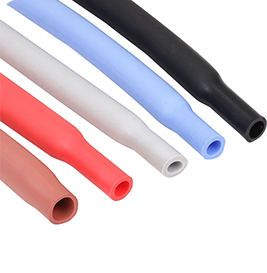
However,the low-temperature performance of silicone heat shrink tubes is also affected by the material formula,the thickness of the tube wall,and the specific usage environment.For instance,in low-temperature environments(close to-60℃or below),some low-quality silicone heat shrink tubes may harden or experience a decrease in elasticity.If applied to cables that need to be bent frequently,the risk of cracking will increase after long-term use.
In practical applications,if the electrical system needs to operate for a long time in cold regions,silicone heat shrink tubes with clearly marked low-temperature resistance performance should be selected and tested in accordance with standards.Meanwhile,during the construction process,it is necessary to avoid forcibly bending or stretching the pipes in low-temperature environments to reduce damage caused by stress concentration.
Overall,silicone heat shrinkable tubes can still maintain good flexibility and insulation performance in common low-temperature environments and are less likely to experience obvious embrittlement problems like PVC or other plastic pipes.However,in extremely low-temperature working conditions,it is still necessary to rationally select the type and use it in combination with actual conditions to ensure its long-term reliability.

